
Wear plates
Wear plates and abrasion resistant plates for heavy industry
Wear resistant plates specified by how your equipment actually wears: sliding abrasion, impact, heat or erosion. Designed, fabricated, supplied and installed by Artha WearTech.
Every plant has a chute, hopper or bend that wears through faster than the rest. Patching it keeps the line running for a few weeks. Replacing it with the right wear plate keeps it running for years.
We supply wear plates for steel, cement, mining and power plants across India, Indonesia and the USA. The plate is chosen after we look at the material, the flow and the failure, because hardness is only part of the story.
Arcoplate 1600 slide rails at a JSW Steel pellet plant measured only 1 mm of wear in a joint inspection after about seven years in service.
Why wear plates wear out
Most wear-out problems come from specifying a plate by hardness alone. A very hard plate resists sliding abrasion well, but it can crack or spall where large lumps land from height. A tough plate absorbs impact, but it thins quickly under fine abrasive flow.
- Sliding abrasion: fine, dry material moving across the plate, as in chutes and hoppers
- Impact: lumps falling from height onto a transfer point or crusher feed
- Heat: hot sinter, clinker or coke that softens ordinary overlays
- Erosion: high-velocity particles in pipes, ducts and fan casings
- Build-up and hang-up: wet, sticky material packing on rough surfaces
Our wear resistant plate range
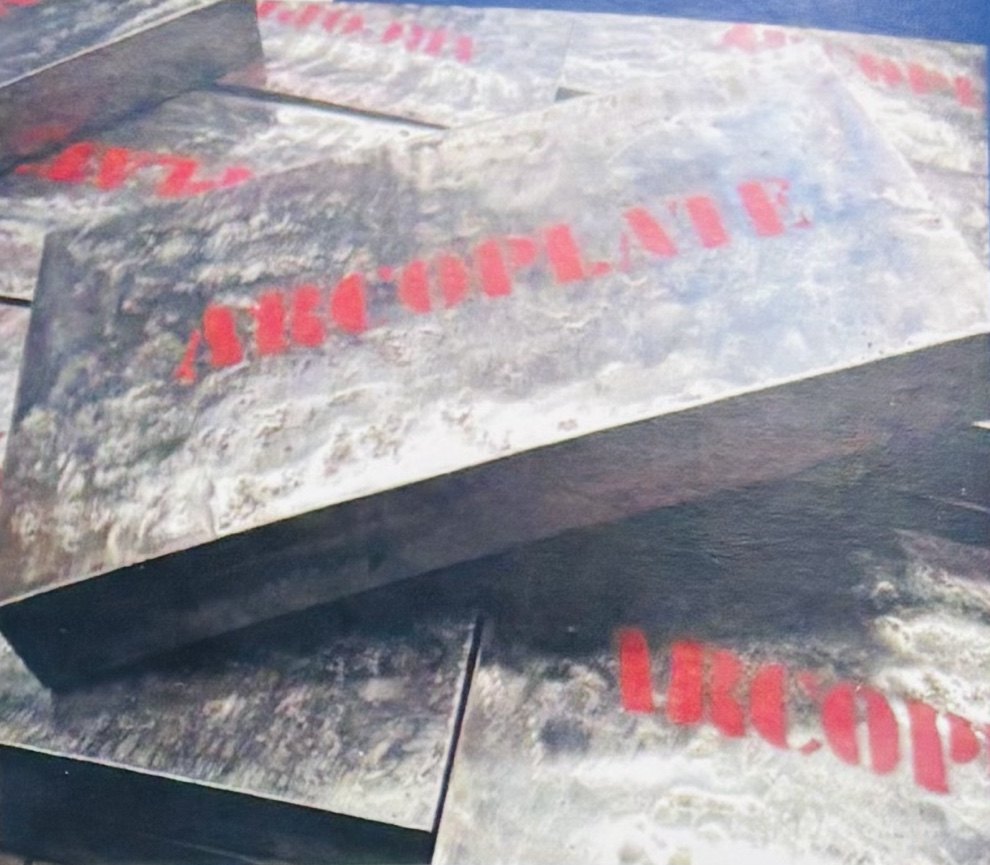
Arcoplate (ARCO) chromium carbide plate
Fused chromium carbide overlay on mild steel with a smooth, weld-free face. Grades include Arcoplate 1600 and 8668.
Learn moreArcoblock impact blocks
Thick white-iron blocks brazed to steel for point-load impact zones.
Learn moreHigh-temperature plates
For hot sinter, clinker and coke where standard overlays soften.
Learn moreHardfacing overlays
Artha Weld tubular electrodes for rebuilding and protecting worn surfaces on site.
Learn moreDesigned, fabricated and installed
We do more than supply sheets. Our team measures the wear zone, designs the liner layout, and fabricates the plates cut, rolled, drilled and fitted with studs or countersunk bolts, ready to install in your shutdown window.
Fabricated work includes chute and hopper liners, screen deck plates, impingement plates, discharge chutes, fan scroll casing liners, classifier curved liners, slide rails and stopper plates.
Where our wear plates are used
- Steel: RMHS chutes, sinter plant hoppers, blast furnace stock house, pellet plant slide rails
- Cement: VRM grit cones, mill inlet chutes, clinker discharge hoods, flap gates
- Mining: ROM hoppers, crusher chutes, transfer chutes, bucket and dozer liners
- Power: coal mill liners, coal handling hoppers, fly ash bends, fan casings
What you get
- Longer liner life between changeouts
- Fewer unplanned stoppages and patch-welding repairs
- Smoother material flow and less hang-up
- Lower maintenance cost per tonne handled
- One accountable partner from measurement to installation
Wear plates
Frequently asked questions
What is the difference between a wear plate and an abrasion resistant plate?
The terms are often used together. An abrasion resistant plate is built to resist sliding wear, while wear plate is the wider term that also covers impact, heat and erosion. We choose between chromium carbide overlay plate, impact blocks and high-temperature plate based on which of those your equipment faces.
Why do my wear plates keep wearing out so quickly?
Usually because the plate was chosen by hardness rather than by failure mode. A hard plate can crack under impact, and a tough plate thins under fine abrasion. We look at the material, drop height, velocity and temperature before recommending a plate.
Do you fabricate wear plates to our drawings?
Yes. We cut, roll, drill and fit plates to your drawings or to our own measured design, and supply them as ready-to-install liner kits.
Which industries do you supply wear plates to?
Steel, cement, mining and thermal power plants, and allied heavy industries, across India, Indonesia and the USA.
Can you supply wear plates for high-temperature applications?
Yes. For hot sinter, clinker and coke we specify high-temperature wear plate rather than standard chromium carbide overlay, which softens at elevated temperature.
Send us the wear zone
Share photos, drawings or the current liner life, and a wear engineer will recommend the right plate.