
Steel wear solutions
Sinter Plant Wear Solutions
Engineered wear solutions for heat and abrasive fines.
Sinter Plant
Zone Introduction
The Sinter Plant prepares iron ore fines into sinter — a stable input for the Blast Furnace.
It is a high-temperature, high-abrasion operation.
If wear causes stoppage → Blast Furnace starves → Hot metal rate drops → Huge production loss.
How wear happens
Process Description
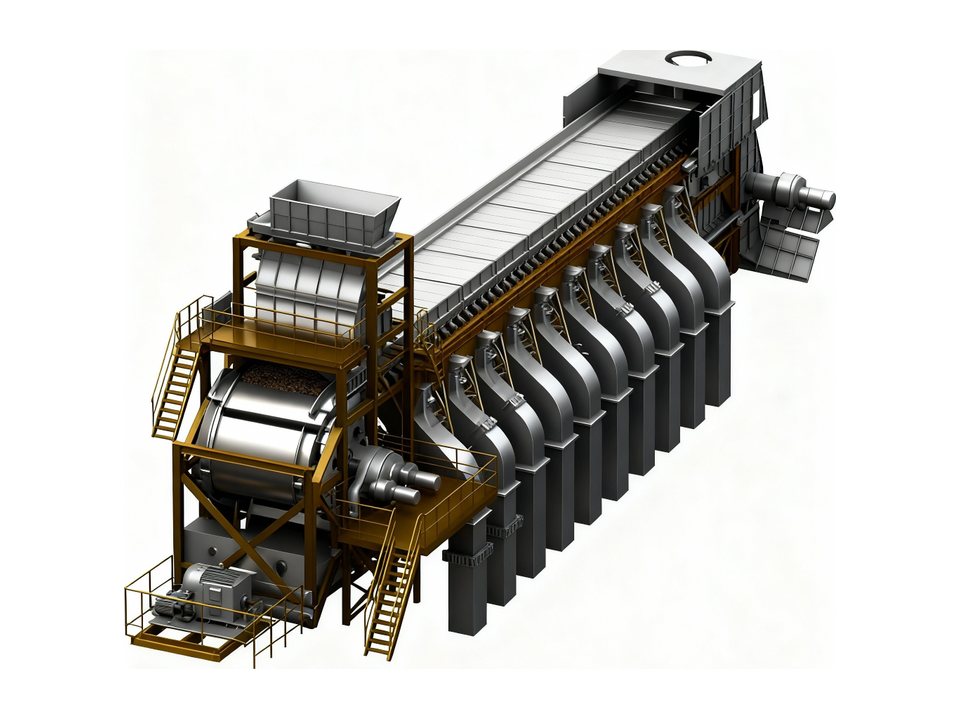
Iron ore fines, coke breeze, and fluxes are loaded on a moving grate and ignited to form hot sinter (>800°C).
The semi-molten material is discharged into crushers and then falls into coolers and transfer chutes.
These materials arrive extremely hot, hard, sharp, and abrasive.
- Hot sinter lumps fall from height Severe impact
- Sharp edges slide along plates High-temperature abrasion
- Silica content Cutting and grooving of steel
- High-velocity gas suction Erosive wear inside wind boxes
- Moisture + dust Corrosion-abrasion
- Temperature cycling Cracking & distortion of liners
- Continuous 24/7 operation Very rapid wear progression
Application · Problem · Artha solution
Applications we protect
| Application | Problem observed | Artha expertise / solution |
|---|---|---|
| Conveyor chutes (Flux & Fuel) | Frequent damage to liners due to abrasion | High wear-resistant liners for extended service life |
| Raw mix bin hopper | Material jamming and poor flow | Smooth, mirror-finished liners to prevent material hang-up |
| Wind box hoppers and wind boxes | Frequent damage due to high abrasion and elevated temperature | Bends and ducts manufactured using High chromium carbide plates for longer service life |
| Movable hopper | Liner damage due to extreme heat and material jamming | High-temperature and wear-resistant liners |
| Vertical chute | Liner damage due to high temperature and impact | High-temperature resistant wear liners |
| Grizzly bars | Frequent replacement due to extreme temperature and abrasion | High chromium Carbide blocks to significantly increase service life |
| Screen deck plates | Damage due to continuous vibration and impact | Superior wear- and vibration-resistant liner plates |
| ESP and bag filter ducts | Frequent damage due to hot and abrasive dust | High chromium Carbide plate bends for extended operational life |
| Impeller cones and vane plates | Rapid wear due to high RPM and elevated temperature | High chromium Carbide plate liners for increased durability |
| Baffle boxes | Conventional refractory-lined boxes last ~1 year | High chromium Carbide blocks increase life significantly compared to conventional refractory linings |
| Hammer crusher secondary chutes | High impact causes frequent liner failure | High wear-resistant liners to extend service life |
| Slide rails | Existing rails last only 2–3 years | High chromium Carbide slide rails provide 4–5 years of life with performance guarantee |
Areas of Wear & Root Causes
- Sinter discharge chutes Hot impact & sliding abrasion
- Sinter cooler decks Thermal-mechanical erosion
- Wind boxes & valves High-velocity dust erosion → Air leakage
- Grizzly bars Repetitive impact → Bending & breakage
- Transfer points Severe wear where direction changes
Performance Loss & Downtime Impact
- Suction leaks Poor sinter quality & reduced productivity
- Choking due to deformation Frequent stoppages
- Increased fuel consumption in BF due to weak sinter
- Unplanned welding & repairs High maintenance cost
- Lower BF hot metal productivity Plant revenue loss
What we recommend
Recommended Products
Artha WearTech Expertise plates
- Handles hot abrasion + impact in discharge zones
- Resists cracking under thermal cycling
- Longer operational life with fewer changeouts
High-Temperature Plates
- Designed for >800°C exposure
- Maintain lining shape & strength
- Zero warpage → Continuous material flow
Artha WearTech Expertise Blocks
- Impact-resistant composite blocks protect strike zones
- Stops localized wear at corners & lips
Total Benefit
- Increased reliability
- Higher MTBF
- Stronger BF supply stability
- Reduced maintenance cost per ton sinter
Ready to put a number on your wear cost?
Send us the application. We will come back with a specification, a campaign estimate and the cost per tonne handled.